
We believe meaningful change begins by listening. By understanding the unique strengths, experiences and aspirations of the people we support, we can deliver services that are person-centred, community-driven and responsive to local needs. Every day, our team works alongside the community to create opportunities, build connections and support people to thrive.
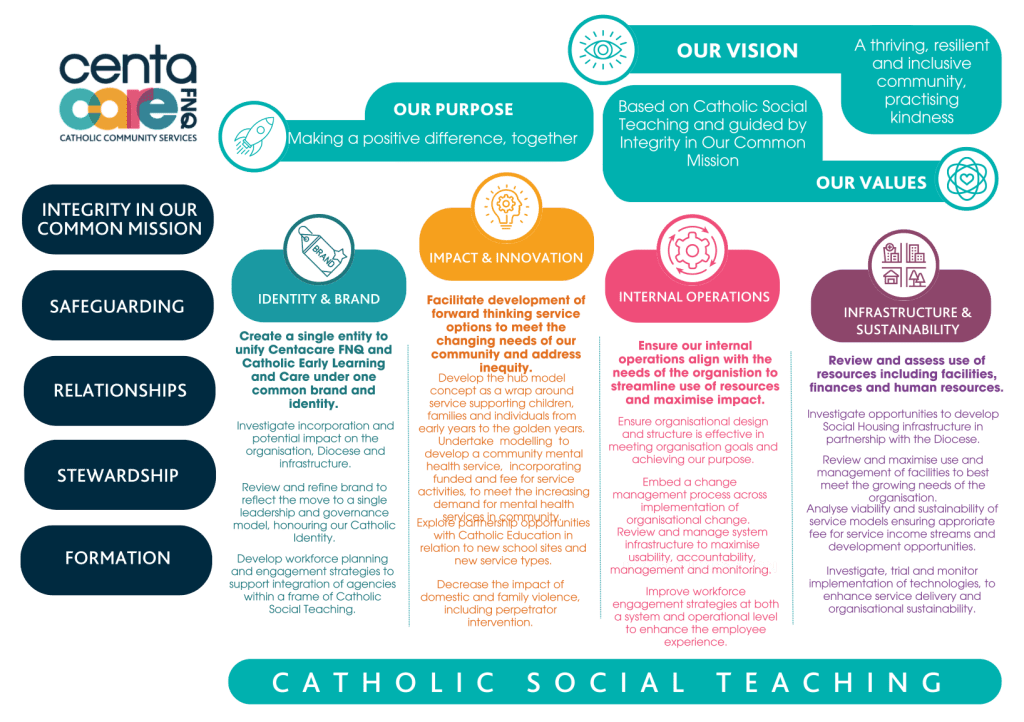
Centacare FNQ works in and with the Far North Queensland Community using the principles of Catholic Social Teaching to guide us.
We acknowledge, value and respect the traditional custodians of this land. We are committed to providing professional, inclusive services, using place-based thinking, and prioritising wellbeing and safety in all we do.
We recognise our shared responsibility to uphold the values and ethical standards rooted in the tradition of Catholic Social Teaching. All our services are grounded in catholic values and a strong commitment to social justice. We acknowledge and affirm that our roles require us to act in accordance with the ethical commitments and values outlined below, as an expression of our identity, faith, and responsibility to the people and communities we serve.
Respect for the dignity of the human person is the bedrock of all Catholic social ethics. We believe that each person is created in the image and likeness of God and is endowed with freedom and responsibility. Hence each and every person is willed into existence by God and is of inestimable worth. Each person reveals something of God’s self; there are no spare or disposable people.
Furthermore, nothing a person might do or that might be done to them can deprive them of their human dignity. The claims that human dignity makes on others can be understood as human rights. They continue to exist even if they are not respected.
The common good is not the same as net aggregate welfare. It is not enough that those who ‘win’ from a change could compensate losers. The common good requires that every person and group in society can actually meet their needs and realise their potential.
Unless everyone is included, it is not the good of all of us as Pope Benedict XVI put it.
Subsidiarity affirms the right of people and groups to participate in decisions that affect them, but there is more to it than that. The element of subsidium – or assistance – from which the principle takes its name, indicates that organisations at a higher level of aggregation have a duty to support or assist those of a lower, or more local order, for the sake of the common good. Thus subsidiarity is about the multi-layered organisation of responsibility among groups at different levels. Participation is an implication of subsidiarity not just another word for subsidiarity.
Solidarity is a firm and persevering commitment to the common good. It is not just a vogue feeling of compassion. When we exercise solidarity we see other people and groups as sisters and brothers whom we are called to love, care for and stand with. It is not only a matter of recognising our common humanity, but also of accepting and valuing others in their differences from ourselves.
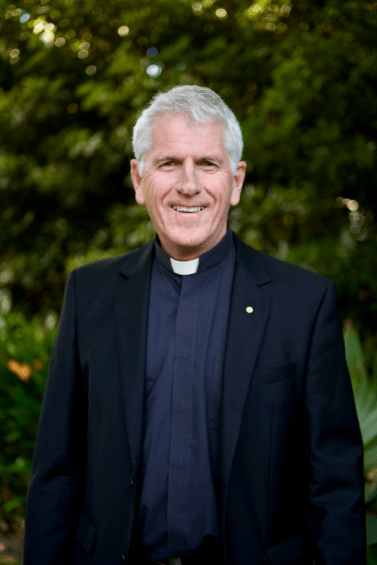
Joseph John Caddy was born on 14 January 1960, the first of six children to John and Patricia (née McMahon) Caddy who are both still living in the family home in Ivanhoe East where he was raised with his siblings Gerard, Anita, Delia, and Julian (all still living within the Archdiocese of Melbourne).
He had a Catholic education attending St Stephen’s Primary School in Reservoir East and then Cathedral College, East Melbourne and Parade College Bundoora for his secondary schooling under the guidance of the Christian Brothers.
Following his secondary education, he was accepted into the Commerce Faculty at the University of Melbourne before entering Corpus Christi College Seminary at Clayton, Melbourne in 1984. In 1988, he was awarded the degree of Bachelor of Theology by the Melbourne College of Divinity.
After ordination in 1990, Father Caddy was appointed, Assistant Priest at Our Lady of Perpetual Help, Maidstone until 1993 when he went to Rome to study for a Baccalaureate and later a Liceniate in Social Sciences at the Pontifical Gregorian University.
On completion of his studies in Rome, Father Caddy returned to Melbourne where he served in a number of diocesan and national roles in social services. He was Chair of Catholic Social Services Australia from 2003 until 2013; served as a Prison Chaplain in Melbourne’s maximum security men’s prisons for eleven years from 2002 and held the role of Chief Executive Officer at CatholicCare Melbourne from 2004 to 2017.
In 2013, while continuing in the role of CEO at CatholicCare, he was appointed Parish Priest of All Saints Fitzroy where he remained until 2016 when he was appointed Parish Priest of St Mary’s, St Kilda East and Episcopal Vicar for Social Services and Justice. In 2019 he was appointed Vicar General in the Archdiocese of Melbourne and in 2021 Parish Priest of St Carthage’s Parish, Parkville while continuing in the role of Vicar General
In June 2018 Father Caddy was recognised in his appointment as a Member of the Order of Australia for “significant service to the community through a range of social welfare initiatives and policy reforms, and to the Catholic Church in Australia”
In June 2024 he was nominated by Pope Francis as the Bishop-elect for the Diocese of Cairns.
We use cookies to improve your browsing experience, understand website traffic, and support relevant marketing. You can accept all cookies or manage your preferences at any time.
Please, complete this form and we will contact you as soon as possible during business hours. Our business hours are Monday to Friday, 8:30 am – 5:00 pm except for public holidays.
^Terms and Conditions
By providing your personal information to Centacare FNQ, you consent to us contacting you by telephone or email for the purpose of responding to your call back request. If you do not provide all of the contact information we have requested, we will be unable to provide the call back service to you. View our Privacy and Confidentiality policy